


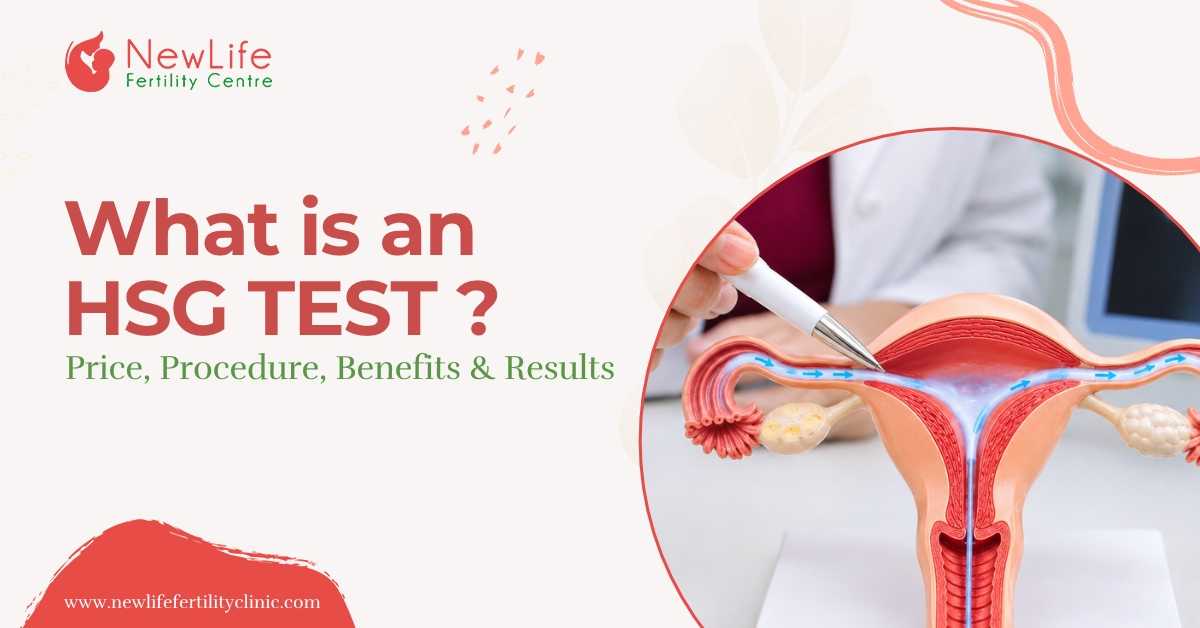


An X-ray test called hysterosalpingography (HSG) helps doctors assess the uterus's morphology and determine if the fallopian tubes are blocked or open. The test can diagnose anomalies that might interfere with the normal process of fertilization. This is done by tracking the passage of a contrast dye through these reproductive structures. Doctors at Newlife Fertility Centre or any other IVF clinic can help with this test.
Fertility doctors can discover potential causes of infertility and plan treatment with information given by the test. An HSG test for infertility is a medical examination for understanding reproductive health and selecting the following steps toward pregnancy, even if it cannot explain every fertility issue.
HSG Test for Fertility Issues – Overview
Hysterosalpingography, or HSG, helps evaluate the uterine cavity and the patency (openness) of the fallopian tubes; it is a minimally invasive diagnostic imaging technique.
A contrast fluid is injected into the uterus or womb through the cervix by the doctor during the examination. After that, X-ray images obtained by the doctor help show how the fluid passes through the fallopian tubes and fills the uterus.
Contrast fluid often enters the pelvic cavity after passing through both fallopian tubes. A blockage may be indicated if the fluid is unable to flow through one or both tubes.
A doctor may advise the test as part of an evaluation for infertility when a doctor suspects tubal-factor infertility or uterine abnormalities.
Why Is an HSG Test Recommended for Infertility?
The ovary releases an egg, which travels via the fallopian tube following ovulation. After fertilization, which often takes place inside the tube, the developing embryo moves in the direction of the uterus.
Sperm and egg may not meet, or the embryo may have trouble moving toward the uterus if the tubes are damaged or obstructed.
An HSG test may help doctors look into a number of potential infertility factors, such as:
Blocked fallopian tubes: Detects any obstructions that can keep the sperm and egg from mating.
- Uterine abnormalities: Assists in identifying variations in the uterine cavity's form.
- Intrauterine adhesions: Scar tissue or adhesions within the uterus may be seen.
- Uterine polyps or fibroids: Polyps or fibroids in the uterus may indicate anomalies affecting the uterus.
- Tubal damage: May reveal information regarding structural alterations brought on by previous inflammation or infections.
When is the Time to get an HSG Test Done?
After menstrual bleeding has finished but before ovulation, an HSG test may be carried out in the first part of the menstrual cycle. Though the date may differ based on the patient's cycle and the clinic's procedure, doctors typically schedule it between Day 6 and Day 10 of the menstrual cycle.
- It may lessen the possibility that the test may be conducted in the early stages of pregnancy.
- The images may be easier to understand since the uterine lining is typically thinner.
- It allows a clearer examination of the fallopian tubes and uterine cavity.
HSG Test Price in India
The cost of an HSG test varies based on the city, diagnostic centre, hospital facilities, contrast material, and additional consultation charges in different parts of India.
The following figures are estimates, not fixed or nationally standardised rates.
|
Location / Facility |
Approximate Price |
|
Government hospital |
Within INR 2,000 |
|
Private diagnostic centre |
INR 1,500–INR 4,000 |
|
Private hospital |
INR 2,500–INR 6,000 |
Disclaimer: The prices listed above are approximate estimates and may vary depending on the city, hospital or diagnostic centre, and available facilities. Actual charges may differ based on consultation, contrast material, and reporting fees. Contact the respective healthcare facility to confirm the latest HSG test price before booking.
How Does the HSG Test Get Done? – Procedure
While the actual X-ray may take a few minutes, the HSG process may take 15 to 30 minutes, often carried out in a radiology department or a medical facility with the necessary equipment.
What may occur throughout the operation is as follows:
Setting up and arranging. In a position akin to a pelvic examination, the patient lies on an examination table at the hospital or clinic. The medical team may verify medical history and describe the process.
Insertion of a speculum. The doctor can view the cervix by carefully inserting a speculum into the vagina, and after that, the cervix is washed with antiseptic solution.
Placing a tiny catheter. A catheter, which is a fine, flexible tube, may be inserted into the uterus through the cervix.
Introduction of contrast dye. Through the catheter, a liquid contrast agent, based on iodine, is gradually added, and it moves in the direction of the fallopian tubes after filling the uterus.
X-ray images. The contrast fluid's movement is captured using fluoroscopy, a type of real-time X-ray imaging. Doctors may watch to see if the fluid enters the pelvic cavity after passing through the fallopian tubes.
Completion of the procedure. The catheter is taken out after images have been captured, and in most cases, the patient can go back home soon after.
Does the HSG Test Hurt?
Each person may have a different experience, and when contrast dye is introduced, some women might only feel slight discomfort. In other instances, some women may endure cramps similar to their periods.
- A little discomfort when inserting the speculum.
- When contrast fluid fills the uterus, there may be brief cramping.
- Pelvic pressure during the imaging process.
- A slight soreness in the abdomen following the checkup.
Benefits of an HSG Test
Evaluates the opening of the fallopian tube. It helps determine whether contrast passage indicates an obstruction or whether the fallopian tubes are open.
Examine the uterus. Certain structural abnormalities, including adhesions, filling flaws, or an irregular uterine shape, may be visible in the images.
Encourages the assessment of fertility. The results offer valuable information that could help doctors understand potential anatomical influences on conception.
Minimally invasive investigation. HSG is typically a quick treatment that doesn't require surgery or hospital admission.
Understanding HSG Test Results. Doctors can evaluate the uterine cavity and fallopian tube patency with the help of HSG results, and the following categories may be used to group the findings.
Standard HSG Report
An HSG report may show:
- A uterine cavity that appears normal.
- It looks like both fallopian tubes are open.
- Contrast dye flows freely into the pelvic cavity after passing via both catheters.
- This implies that there isn't a clear structural obstruction in the fallopian tubes.
Normal results do not, however, imply pregnancy, and fertility may also be influenced by ovulation, egg quality, sperm health, and embryo development.
Unilateral Tubal Blockage
This may indicate that one fallopian tube appears to be blocked while the other may still be open. Depending on other fertility characteristics and general reproductive health, natural conception may still be possible.
Bilateral Tubal Blockage
When both fallopian tubes seem obstructed, it is referred to as bilateral obstruction. Because the egg and sperm might not be able to meet, this discovery could have a big impact on natural conception.
Abnormal Uterine Cavity
An HSG could show anomalies like:
- Polyps in the uterus.
- Submucosal fibroids.
- Adhesions within the uterus.
- Congenital anomalies of the uterus.
Can an HSG Test Increase the Chances of Pregnancy?
In the months after an HSG test, some women naturally become pregnant. Because of this, there may be a perception that the surgery can increase fertility.
The contrast fluid may be able to clear the fallopian tubes of small debris or mucus plugs. After tubal flushing, certain studies have shown a brief rise in pregnancy rates might be associated with oil-based contrast agents.
Moreover, HSG should be viewed more as a diagnostic technique than a fertility treatment.
Risks and Possible Side Effects of an HSG Test
Typical transient side effects may be:
- Mild cramping in the abdomen.
- Vaginal spotting is mild.
- Vaginal discharge that is sticky or watery.
- A brief feeling of nausea or vertigo.
Final Words
Because this X-ray lets doctors inspect the uterine cavity and help determine whether the fallopian tubes are open, the HSG test for infertility may be vital in many cases. HSG can detect some uterine abnormalities and probable tubal obstructions, which may give information for future reproductive treatment planning.
Consult your fertility doctor for an HSG test.
FAQs
1. Is an HSG test necessary for infertility?
It may be advised when doctors need to evaluate the patency of the fallopian tube or look into possible uterine anomalies.
2. What is the duration of an HSG test?
It might take 15 to 30 minutes.
3. Can I conceive naturally after an HSG test?
If at least one fallopian tube is working and the other reproductive variables are favorable, spontaneous pregnancy may still be achievable.
4. Can blocked fallopian tubes be detected by an HSG test?
Though certain results might need to be verified, it can detect suspected obstructions in one or both fallopian tubes.
5. Is it safe to take an HSG test?
It is usually safe when carried out under medical supervision.